Digging at the Ice - On Penguin Colony (Plus an Autumn Update)
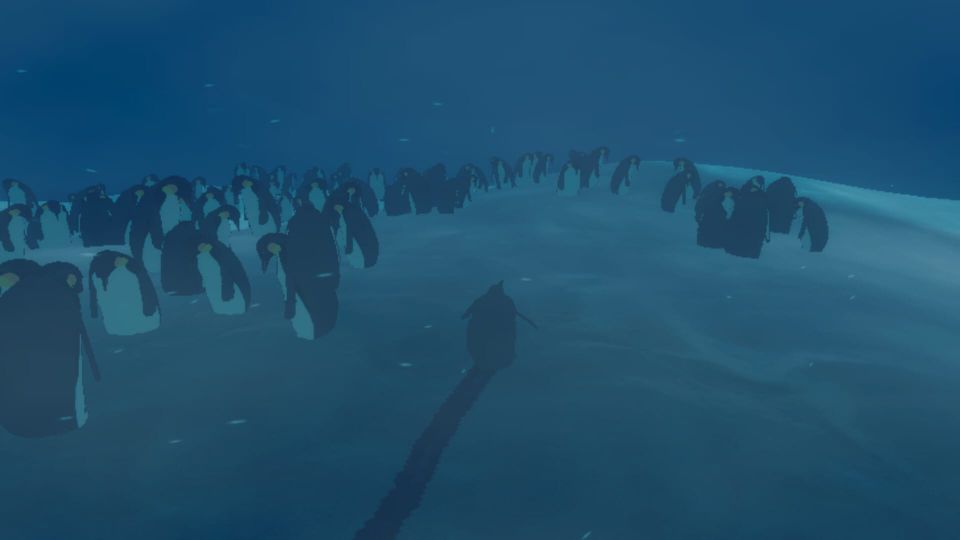
Hey everyone. Hope the last few months of 2026 are treating you well. Two things today: an overall brief update on the stuff I've been working on and some brief thoughts about Penguin Colony, the latest game from ORIGAME DIGITAL, creators of 2020's Umurangi Generation, an all time fave of mine.
Notes on Penguin Colony
I was writing this as a thread over on Bluesky, but I hit four posts and was like, I should just drop this on my newsletter, that's where things like this should live. So, here it is. It's gained a few words (many of which I stole from my own delibrations during IGF). I hope they are useful words.
As I said above, Penguin Colony is the latest game from the makers of Umurangi Generation, a game I raved about at launch and which has only grown in my estimation. I played through it during my time as a judge in IGF this year, and because it's a game with a lot of hidden corners and secrets, and I was only able to play through it once, a couple of weeks ago. I say that because I have reasons to suspect it's a game that rewards replays and (especially) conversation with others who have played.
It is openly a retelling (and, perhaps, a hostile retelling) of Lovecraft's novella "At the Mountains of Madness." A detail in that story–about academics delving too deep at the end of the world and uncovering a unearthly history—is that a a particular sort of penguin ends up as prey to an otherworldly power. Here, you play as different sorts of penguins who traverse Antarctica, witnesses to a group of Nazis as they become obsessed with something ancient under the ice, desperate to find a guarantor of their own supremacy.
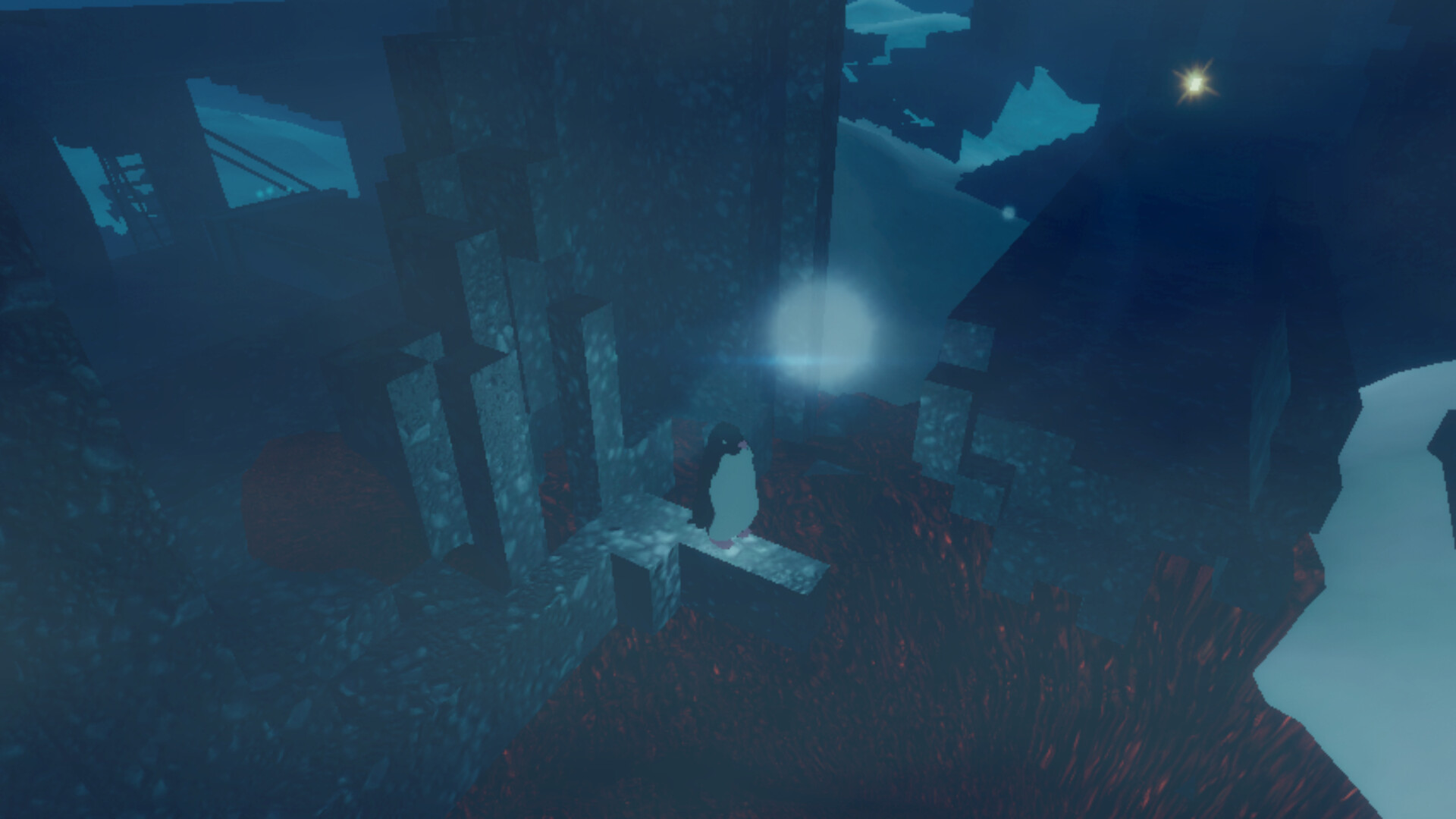
You waddle, slide, swim, and climb your way across an icy, lo-fi wasteland, through military checkpoints, into ancient ruins, and beyond. Occasionally, you swap from one penguin to another in order to make that easier: The Rock Hopper jumps and climbs better than the Emperor Penguin, but the Emperor Penguin can stand on heavy buttons.
You'll want to master how these penguins move, because scattered across the levels are little glowing orbs, each connected to a politically charged word like "violence" and "purity. And video games have taught me that it is good to collect little glowing orbs. Yes, between the penguin sub-types and the orb collecting, it is fair to say that Penguin Colony is game really engaged with the structure of the puzzle platformer specifically and the commercial video game more broadly.
Despite this simple format Penguin Colony does some remarkable things with its storytelling. While there are occasional set pieces, it largely communicates its tale through a combination of environment design and the sonorous, haunting narration from Lenval Brown, playing a person who was there for mysterious (yet clearly complicit) reasons, seeing it all go down. Much of this narration triggers through regular progress, but some comes through orb collection. (Additional collectibles reveal archival photos and dialog lines from those who'd made the journey).
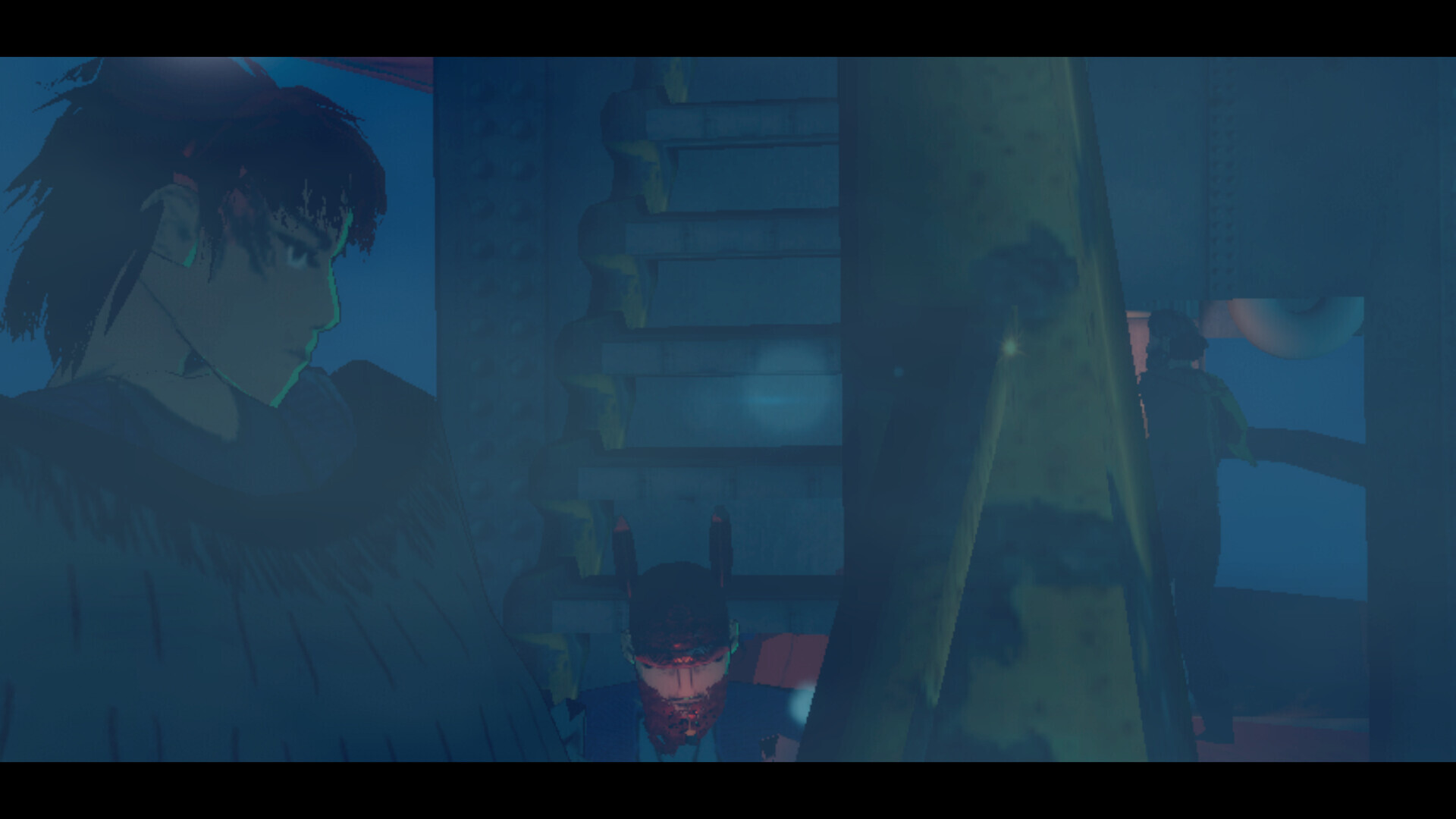
Intercut with all of this is a more experimental style of storytelling, tracking the arrival of a group of Kaitiaki, Māori guardians who move with the sort of purpose born only of foreknowledge and obligation. These sequences flash by, communicating like montage, in the sudden and shifting arrival and departure of sensation. You move a character for a few seconds; you briefly adopt a new mode of traversal; you learn to look at a HUD you've never seen before. These moments are sharp to the point of cutting.
And then there is the ending, which felt as in conversation with Metal Gear Solid 2 as with anything in Lovecraft's oeuvre.
I went in knowing that Penguin Colony would be an anti-racist reworking of a well known Lovecraft story, but I think it takes a different turn than something like Victor LaValle's The Ballad of Black Tom or Lovecraft Country (at least Misha Green's show, I haven't read Matt Ruff's original novel).
Those are stories that center the ways that those of us who already have some skill operating under repressive, dehumanizing, and illogical systems of power might manage when we confront arcane and alien powers that see us all as little more than slaves or ants. But PC takes a different tack, drawing more deeply on some of the less often integrated parts of the Lovecraftian Mythos, to make a really strong argument about the nature of fascism and emprie.
And on top of that stuff, it has a second (connected) narrative project of looking at who gets to tell what stories, and what happens when those stories take different forms. How do the conventions of the Mass Market Video Game shape a story of resistance, for instance? This is also where some of the most interesting friction is—and there is plenty of friction. This is a game with hard, hard edges.
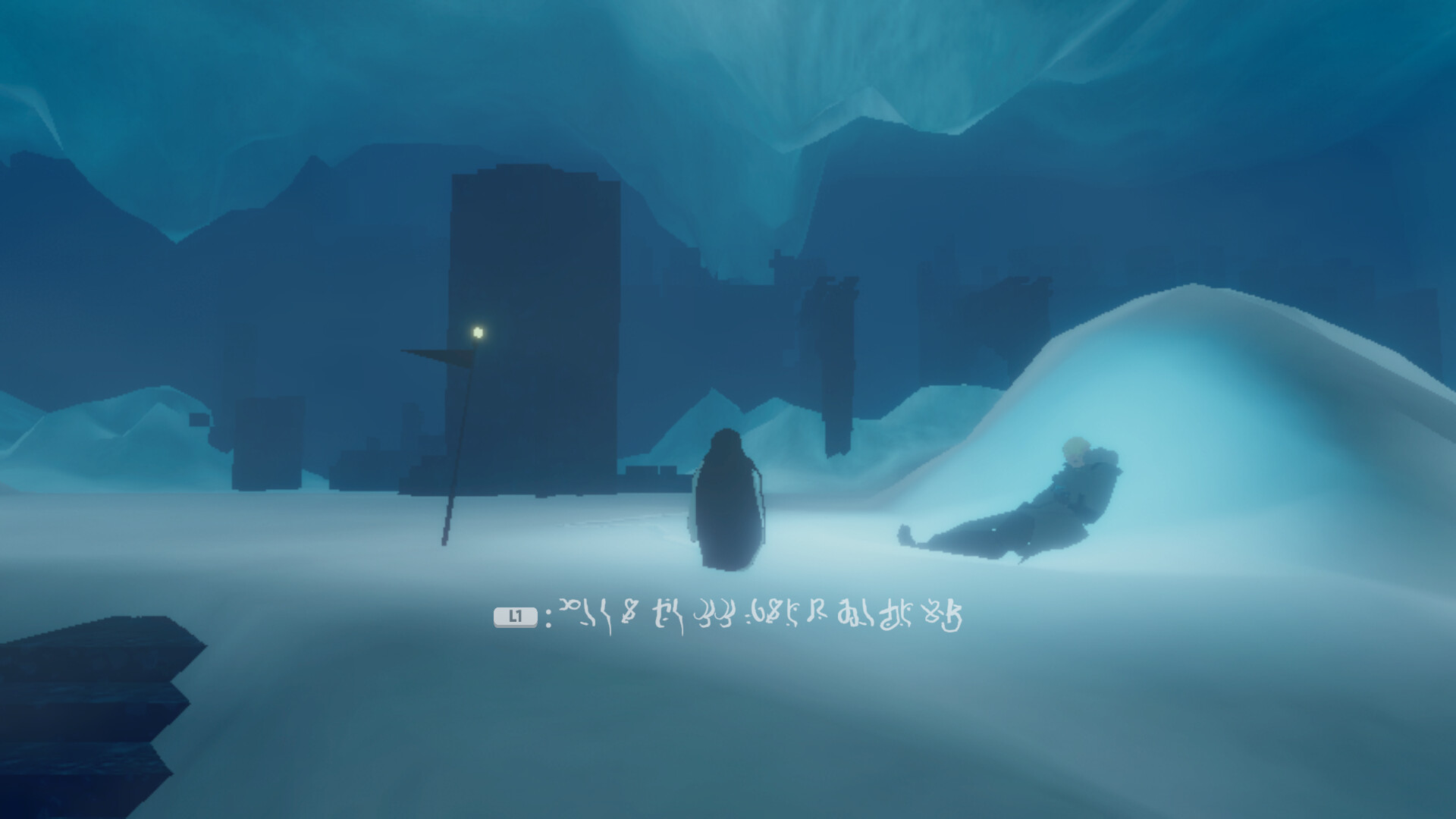
Penguin Colony's first chapter is wide and open, an antarctic plain with dips and hills, dotted with campgrounds and radio towers and crash sites, all connected by long stretches of ice, snow, and water. It's a space designed to learn the controls, stumble into narrative place-setting, and get into the overall vibe of the game.
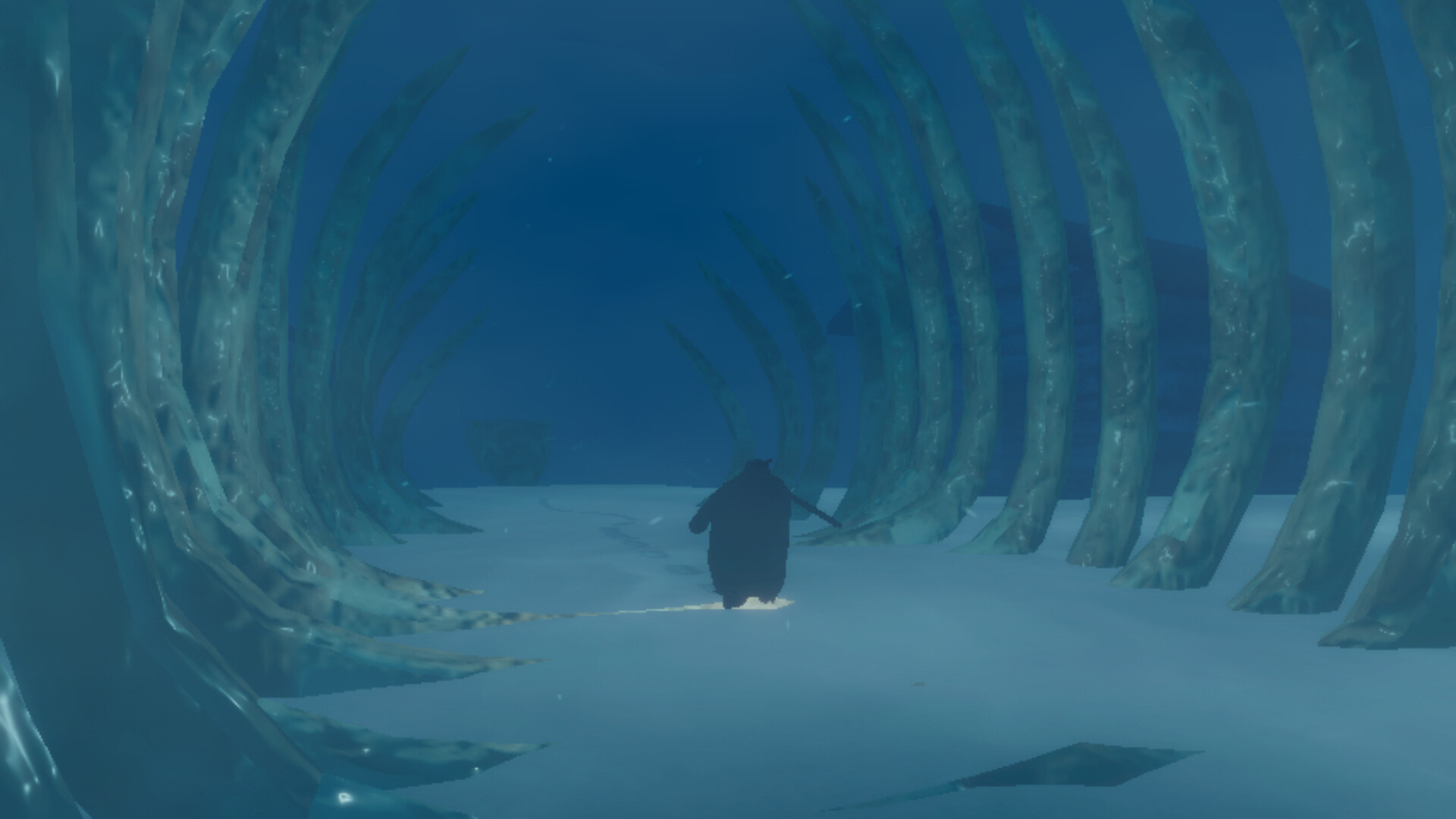
The rest of the game narrows into tighter and darker spaces. Dead end hallways. Lethal chasms. Obstructed views. In part, this becomes a perfectly clear metaphor: This is a natural space that has been colonized by a modernity that demands a penguin awkwardly climb up a ladder. It's supposed to be alienating. But in time, you'll see that it is also a space much older than the human.
Worse, the metaphor risks becoming lost in regular old frustration. The game's second chapter breaks a cardinal rule, for me, which is that when you press the button that you've been taught will turn and face you towards your objective, you are instead faced towards level boundaries and false pathways. The only way forward is incredibly unintuitive, and even on one repeat attempt, I found myself falling for old navigational hazards.
From Chapter 3 onward, the level design became more functional, while still allowing exploration into dark corners and hidden passageways). The navigational direction button never falters again, and the narrative pace picks up dramatically. But I suspect that Chapter 2 will be a real wall for players. If you are that player, look up a guide and press forward.
A more interesting (and likely more purposeful) friction, though, is the deep contrast between the game's design and its story.
As I said above, Penguin Colony is loudly post-colonial and anti-fascist. Center to that is a rejection of the idea of a linear, teleological, technological, and eurocentric sort of progress. There is a constant, roaring revulsion against occupation and extraction. There's even a sort of skepticism around ludic narratives of heroic violence, or at least some critical gestures at why this game operates from a non-anthropocentric perspective.
And yet... There's a stamina meter. There are enemies that will kill you and make you respawn at the start of a section. There are endless pits. And maybe most importantly (and certainly most discordantly), there are the aforementioned distinct Penguin Species, which are statistically typified and each granted specific skills and aptitudes. I get excited when I get a Rock Hopper because it means I can Platform Better. I switch to the Emperor Penguin when it's time to push down a button.
How does all of this fit into the critique of games that's gestured at? How does it hang alongside the anti-fascism, which fundamentally rejects the racial categorizations of the Nazis? How does it fit alongside all of the dialog about slavery's place in empires across ages? How does this align with is its own retro aesthetic, and that style's interest in a past which sometimes idealizes and sometimes (eagerly and rightfully) perverts?
Perhaps it is clear because I leave them as questions, but I do not think it resolves these questions. I think it geleefully sits in the ambiguity.
For days after playing, I was left wondering about this intersection between its wonderfully angry distaste for the self-serving illogic of Nazi (and broader, white, western) racism and its core design that has you instrumentalizing the qualities of different Types of Penguins. Is it self-critique? Is it limits of the form? Is it just ORIGAME DIGITAL falling in love with their game feel, and wanting one penguin type that jumps good and one that swims fast?
In its final moments, Penguin Colony reveals how much you have uncovered in your time in Antarctica, and openly invites you and other players to keep paying, to engage with its remaining mysteries and with each other. So, maybe there will be a fan theory that will make it all click for me. Maybe there was a hidden alcove buried in the bones of a ancient world, an alcove filled with light and answers. Maybe there is an orb out there waiting for me which will lock things into place and reveal the secret line that runs through it all. Maybe.
What I've Been Up To
As for me...
Realis, my first tabletop RPG, is now available for post-Kickstarter pre-order and about to go to print! (Also, while you're there, please pick up my friend and podcast co-host Cameron Kunzelman's Path Apparatus).
The final version of Realis is gorgeous. If you know me personally, you know I go through a real arc with my own work, and I'm grateful I'm through the "deep skepticism and distaste of all that I've touched and done" phase and into the "hey, I made a pretty cool thing" phase. All it took was the incredible work of 17 different artists, a ton of support from my publisher and editors, and sitting with a final draft that makes my words really pop off the page.
I've gestured at it a few times off handedly in the past few months (including on last week's Remap Radio), but back in the Spring (basically right as the Realis writing and editing train was coming to a halt), I started back up full time in the video games industry.
I'm over at the excellent 2Weeks, which you might know as the crew that released Guild Wars Reforged last year (and recently brought it to phones). The studio was founded by two of my old co-workers at Possibility Space, and they brought me on as Creative Director to lead a non-Guild Wars project that I can't say too much about yet, except that I'm really excited about the world and design ideas I've been building. (And that hey, if you're someone who publishes independent games and thinks that a game helmed by me might be interesting, get in touch).

Beyond that, we're at the waning side of various podcast seasons:
- Friends at the Table's Perpetua season is hitting what I've been secretly calling "the end of Disc 1" very soon. We've got a few more recordings to do, then we'll take a little break and move on to something new.
- A More Civilized Age just wrapped up our Doctor Aphra coverage, and we're about to kick into gear for a season covering Zero Company, which I haven't played more of since our first episode on it. Excited to finally finish it.
- And over on Shelved by Genre, The Lord of the Year (our year of reading and covering the works of J.R.R. Tolkien) will be wrapping soon. Just one more Silmarillion episode left, and then some fun bonus stuff. It's been an absolute joy even when I struggle with what Tolkien's written. Indeed, the joy is in the struggle.
As always, the best way to support me is to support me and my friends who I love to make all this cool stuff with. So go check us out on the Patreons: FatT, AMCA, and Ranged Touch.
That's it for me. Oh, I'll be at PAX Unplugged at the Possible Worlds booth in early December. I'd love to say hi and sign copies of Realis.
Peace.